The AI Hiring Reality: What's Actually Happening in the 2026 Job Market
May 18, 2026
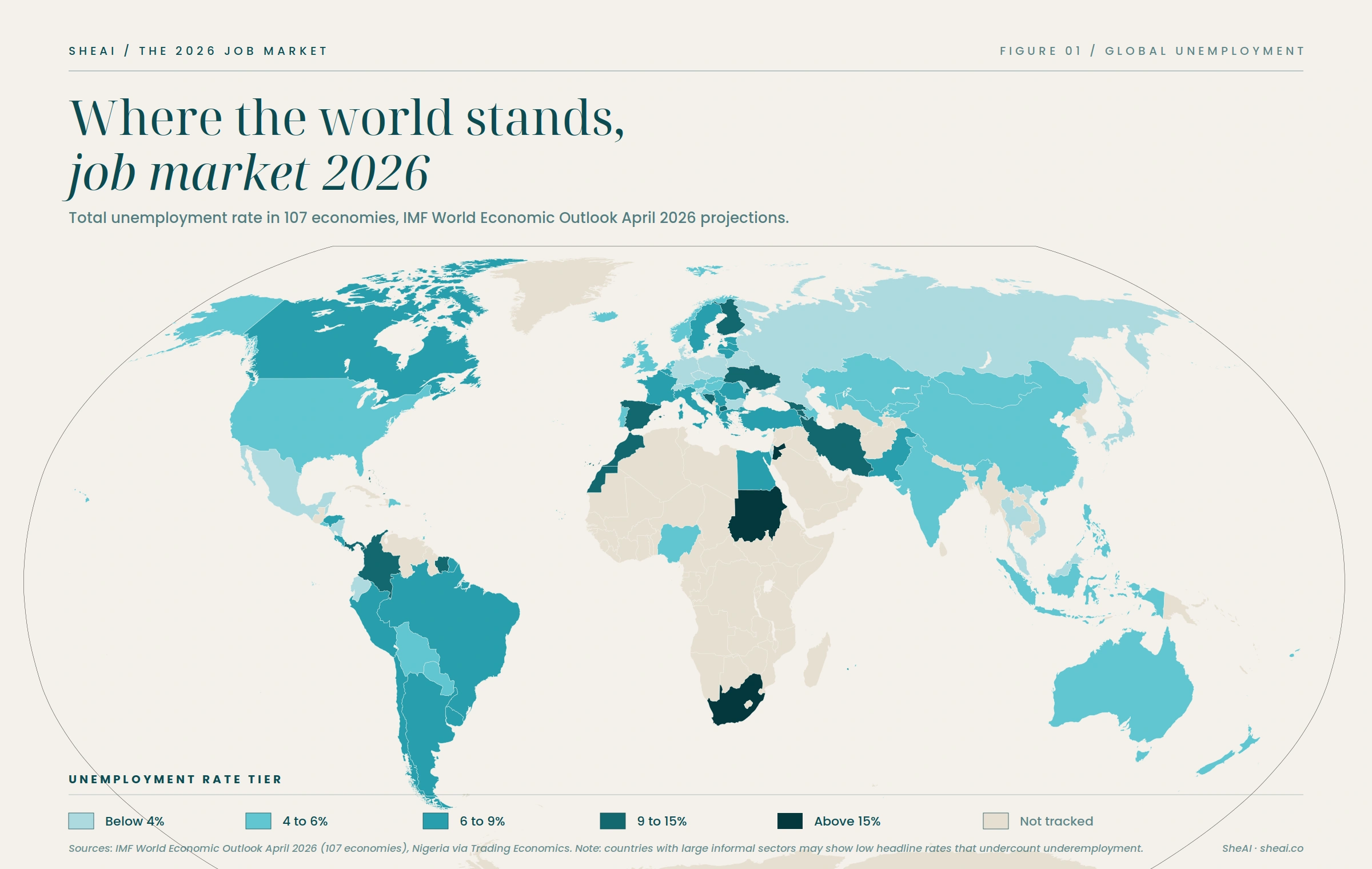
If you are looking for work right now, you already know it is harder than it should be. Layoffs are up. Entry-level roles have thinned. Unemployment and unemployment rate data vary by country, but the pattern is consistent: slow growth, elevated policy uncertainty, and structural shifts in labor supply have produced one of the most disorienting job markets in recent memory, especially for early-career professionals and college grads. The economic impact is real, and it is uneven.
Here is what is also true: this is not just a difficult market. Its very core has changed. AI has infiltrated hiring at every stage, from the automated resume scan to how recruiters source candidates before a single application is filed. Most people are still operating as if it is 2021. That gap is where your advantage lives, if you know how to use it. At SheAI, our job is to make sure you do.
The data is unambiguous on the direction of travel. Overall job postings sit barely 6% above pre-pandemic baselines, yet job postings explicitly mentioning AI or AI-related skills have surged by more than 130% over the same period (Indeed Hiring Lab, Jan 2026). The overall hiring market is cautious. Within it, AI-literate candidates are the exception that the market rewards.
For women professionals, the picture is complicated by a structural problem that extends well beyond the individual job search. The World Economic Forum analysis found that women are disproportionately concentrated in the roles most at risk of AI-driven disruption, while remaining underrepresented in the AI-augmented roles being created to replace them (WEF, Mar 2026). And we think that is not a reason for pessimism. It is a reason to move deliberately and wisely!
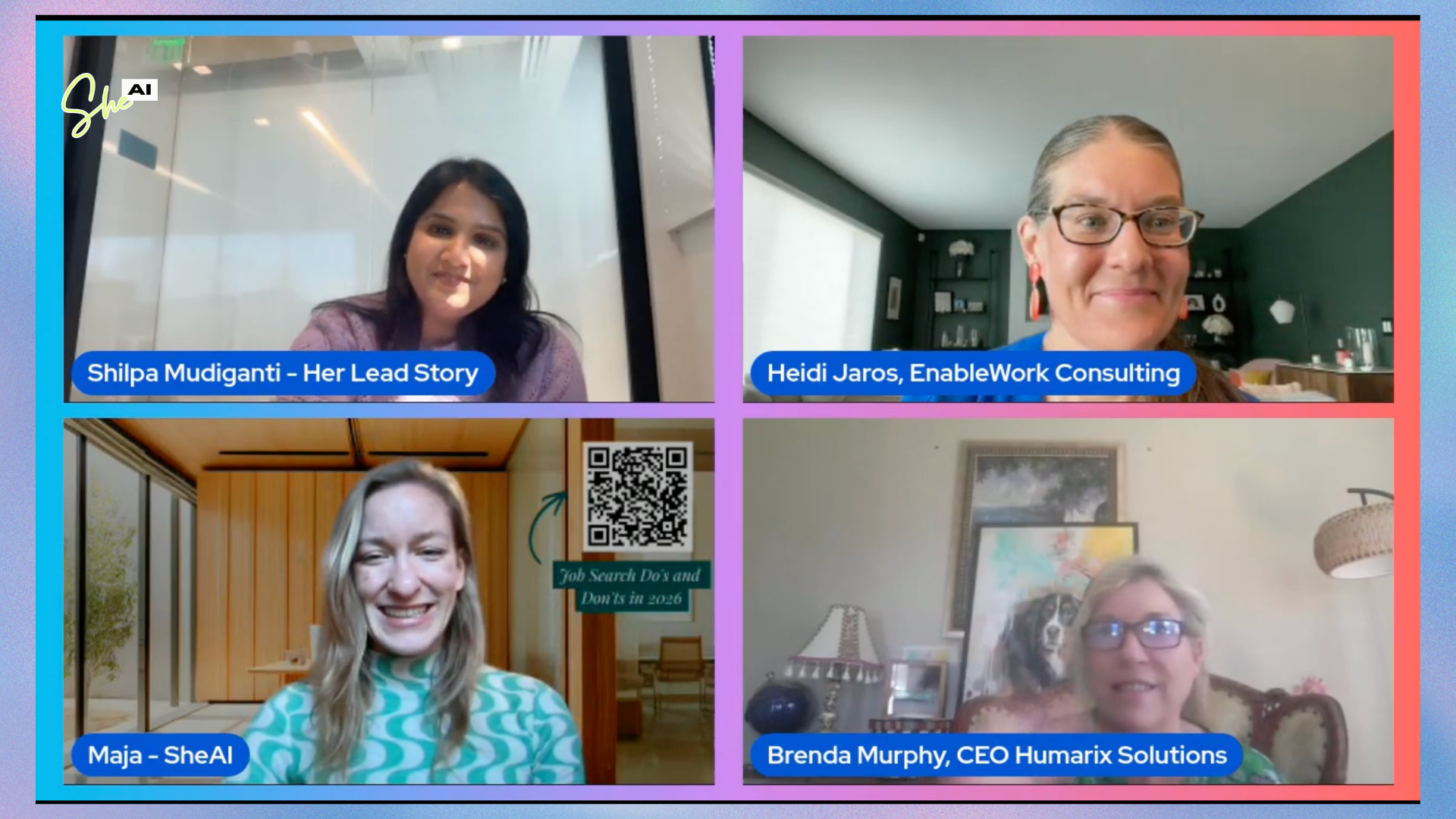
In this article, we wanted to gather recent labor market research, hiring data, and insights from our LinkedIn event organized by SheAI in collaboration with Her Lead Story, featuring Maja Završnik (Co-founder and CMO of SheAI), Shilpa Mudiganti (Founder of Her Lead Story), and Brenda Murphy (former Fortune 50 CHRO), moderated by Heidi Jaros (Owner of EnableWork Consulting). The panel was a practical briefing by people who see hiring from the inside, and the conversation they shared closely aligns with what the research shows and with how to tackle the challenging job market now.
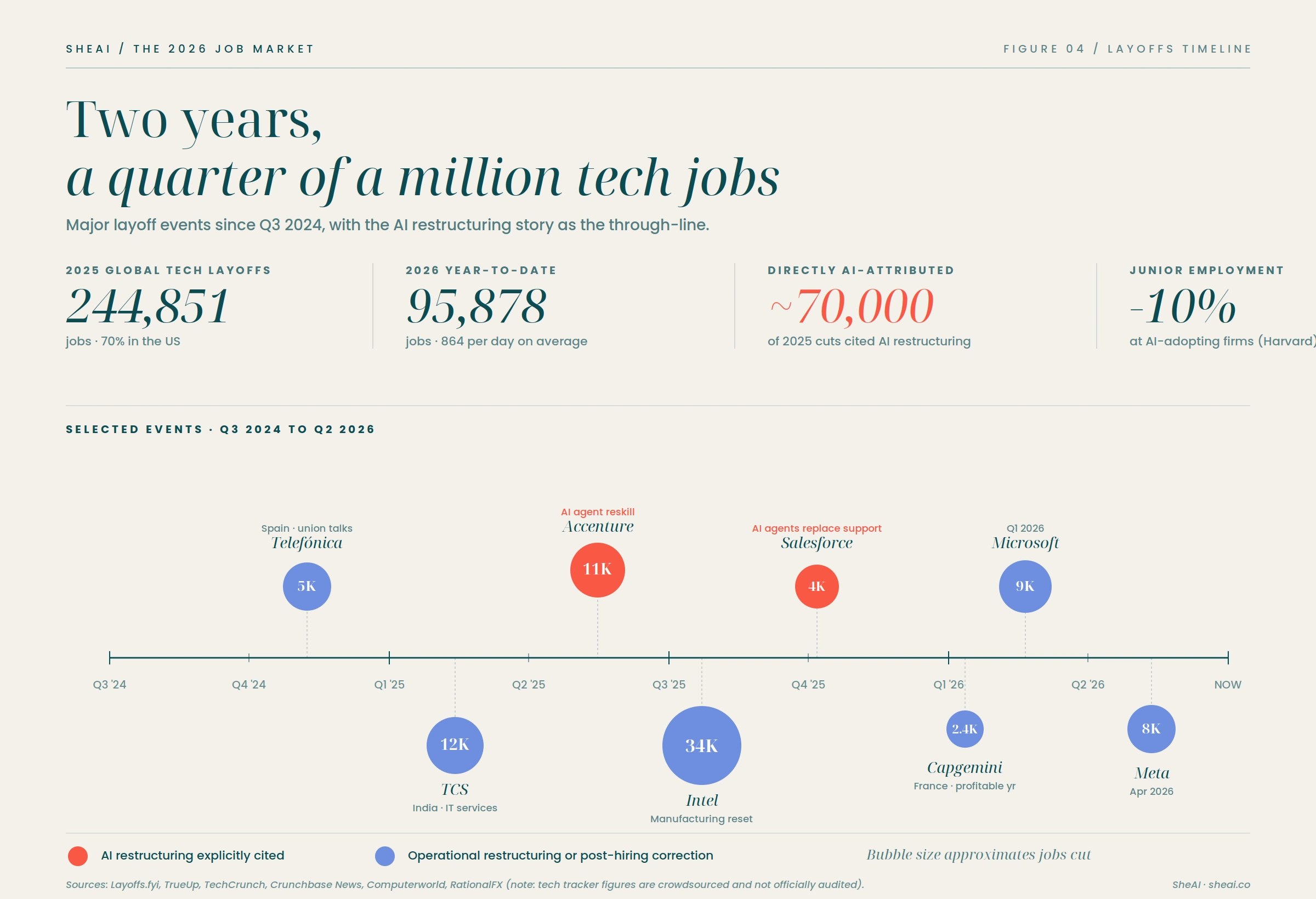
Layoffs and the insecure job market in 2026
Before we dive into practical advice, let's take a look at the current state of the employment market and the infamous.
How is AI changing the job market in 2026?
AI has restructured hiring at every stage. Automated resume screening now filters out an estimated 75% of applications before a recruiter sees them. Employers are actively deprioritizing traditional qualifications in favour of skills-based hiring, with documented AI fluency increasingly functioning as a baseline requirement rather than a differentiator. At the same time, the roles being created to replace automated functions require the human capabilities AI cannot replicate: judgment, contextual communication, and cross-functional leadership. The net effect on job growth is not simply negative. It is a structural reorganization of what employers are paying for.
Is the job market really that bad in 2026?
It is difficult, but the picture is more specific than the headlines suggest. Layoffs are concentrated in particular sectors and seniority levels, while job openings in AI-adjacent roles are growing fast. LinkedIn’s Work Change Report found that hiring for AI-adjacent talent has grown 300% over the past eight years, with a 30% acceleration in postings since autumn 2024. The challenge in early 2026 is not that there are no jobs; it is that the market conditions have shifted and the criteria for those jobs have changed faster than most candidates have updated their positioning.
What jobs are most at risk from AI in 2026?
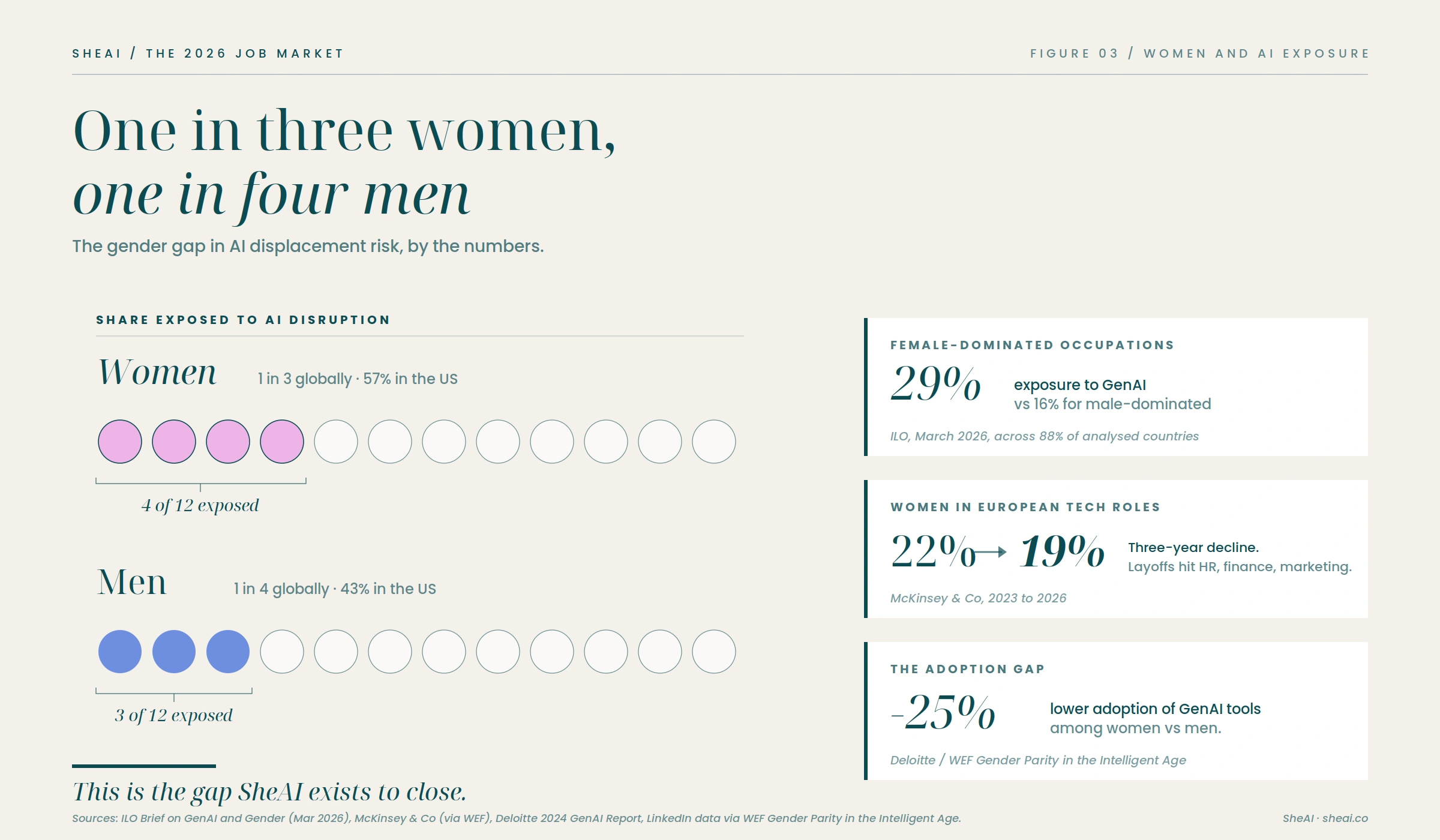
The ILO’s March 2026 brief identified clerical and routine cognitive roles as most exposed to automation. These include data entry, standard reporting, document processing, and administrative coordination. Women are statistically overrepresented in these categories, which is why the transition carries a specific risk for female professionals who are not actively building AI-adjacent skills. The answer is not to avoid these roles but to document how you are using AI within them, which shifts your profile from at-risk to AI-enabled.
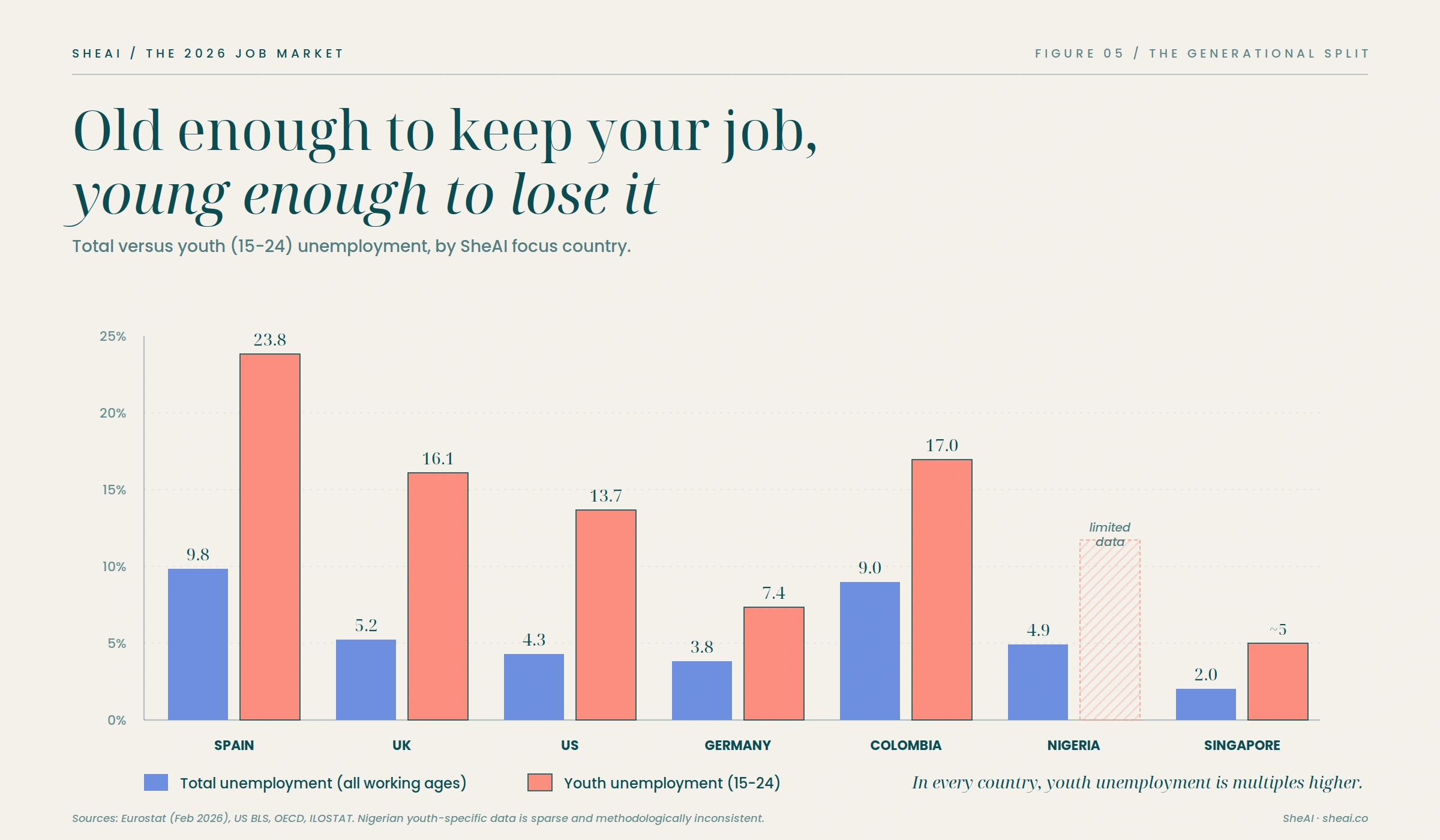
Is the job market different for college graduates and early career professionals in 2026?
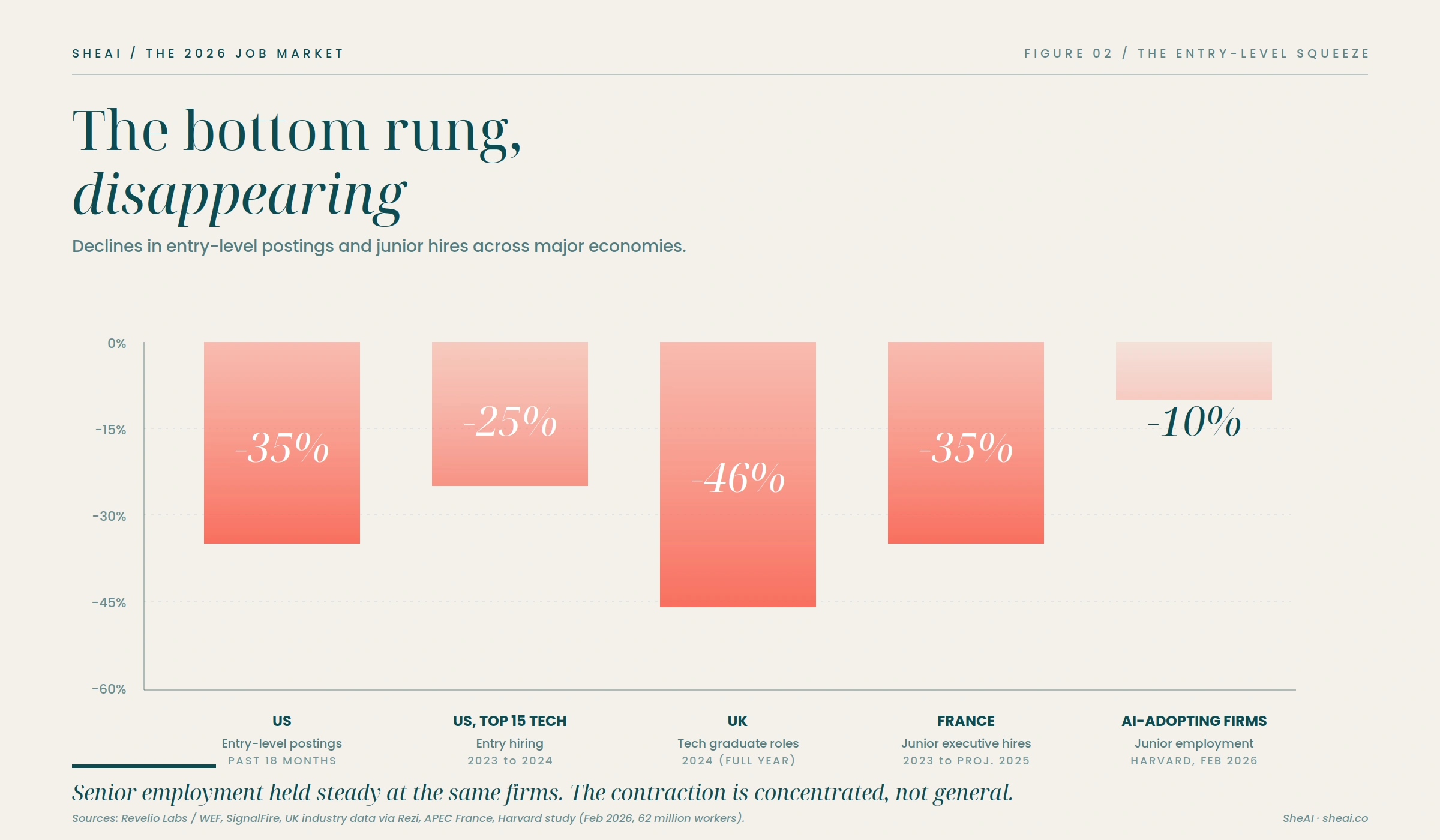
Yes, and meaningfully so. College grads and those in the class of 2026 entering the market face compressed entry-level hiring in traditional sectors, with companies using AI to absorb tasks previously assigned to junior roles. The advantage available to early-career professionals is speed: you can build a documented portfolio of applied AI competence faster than someone mid-career who needs to unlearn existing workflows. Fractional and project-based work is particularly accessible as an entry point. Three documented case studies showing how you applied an AI tool to a real problem are more persuasive to a 2026 hiring manager than a certification.
How has AI reshaped the applicant screening process?
Applicant tracking systems are not new. What is new is how thoroughly AI has been integrated into them. According to a 2026 Azumo analysis drawing on SHRM, LinkedIn, and Deloitte data, 99% of Fortune 500 firms now use AI in their hiring process, and AI adoption among HR professionals rose from 58% in 2024 to 72% in 2025, with 93% of recruiters planning to increase their use of AI tools in 2026 (Azumo, 2026).
The practical effect at the application stage is stark. Harvard Business School research estimates that 75% of resumes are rejected by ATS before a recruiter ever opens them (ResumeAdapter / HBS, 2026). Similarly, 88% of employers believe they are losing qualified candidates because those candidates are not submitting ATS-optimized applications (SelectSoftwareReviews, 2026).
The formatting errors that cause most failures are straightforward to fix. Two-column layouts, text boxes, embedded graphics, and tables cause ATS systems to return a blank profile to the recruiter. Modern ATS can now parse context and underlying patterns, not just exact keyword matches, but they cannot parse a design file masquerading as a document.
"Start with a clean single-column document in a standard font. Mirror the language of the job description for skills you can actually back up in an interview. Replace vague claims with numbers: “reduced reporting time by 30%” outperforms “improved efficiency” at every stage of screening. The candidates who move forward are not the most aesthetically designed applications. They are the ones the system can actually read." - Brenda Murphy, former Fortune 50 CHRO
The scale of ATS adoption varies by market, and so does what it means for your application strategy. In the United States and United Kingdom, ATS screening is nearly universal in enterprise hiring. Platforms such as Workday, Greenhouse, and iCIMS dominate, and a clean, single-column document is non-negotiable. In Germany, the hiring culture has historically favoured detailed, structured CVs sent directly to HR departments, often as PDFs with a formal cover letter and a photograph. ATS adoption is growing in German multinationals, but the small and mid-size Mittelstand sector still relies heavily on human-reviewed applications, which means formatting rules are less critical and relationship-building with the hiring manager carries more weight. In Spain and Colombia, corporate roles in international companies follow ATS norms closely, while local and public-sector hiring often involves a more document-heavy, committee-reviewed process. In Nigeria and Singapore, large employers and multinationals use ATS consistently; local and regional firms may not. The principle holds everywhere: if you are applying to any organisation with more than 100 employees, assume a system is reading your CV before a person is.
AI literacy is the new baseline
The framing of AI as a competitive advantage is fading. A US reserach found that 42% of employees expect their role to change significantly due to AI within the next year, yet only 17% use AI tools frequently today. Meanwhile, 42% say their employer expects them to learn AI independently (Bright Horizons / Harris Poll, Dec 2025). The gap between expectation and support is significant, and it is a gap that candidates are expected to close on their own time.
What employers are increasingly paying for is not the use of AI in the abstract. According to the Top Employers Institute’s 2025 report Building a Skills-First Workforce, drawing on data from 2,300 organizations across 125 countries, companies are actively deprioritizing traditional qualifications in favor of skills-based hiring, with “learning agility” ranking as a top-three criterion for candidates across sectors (Top Employers Institute, 2025).
PwC’s AI Jobs Barometer quantified the salary premium: workers with advanced AI skills earn 56% more than peers in the same roles without those skills (PwC AI Jobs Barometer, 2025). And accordieng to LinkedIn, global hiring for AI-adjacent talent has grown 300% over the past eight years, with a 30% acceleration in postings since autumn 2024 alone (LinkedIn Work Change Report).
“Instead of just listing that you know how to use ChatGPT or Claude, you need to clearly demonstrate your strategic thinking by explaining how you have integrated AI into your workflow to optimize processes.” — Shilpa Mudiganti - Her Lead Story
That framing matters for how you present yourself at every stage. Listing tools is table stakes. Describing how a specific tool changed a specific process and the measurable result distinguishes a literate candidate from a capable one.
SheAI advice: Audit your current CV and LinkedIn profile for mentions of AI. If they say “experience with AI tools,” rewrite them. Name the tool, describe the workflow change, and state the result. Make it concrete: “Rebuilt our client reporting process using Claude, reducing turnaround from three days to four hours”.
The salary premium for AI skills is documented globally, but the gap between markets is significant. PwC’s data is weighted toward the United States and Western Europe, where AI investment and hiring budgets are concentrated. In the UK, the premium is real but compressed in public-sector and third-sector roles. In Germany, the skills-based hiring shift is moving more slowly through traditional industries, though tech, automotive, and financial services are accelerating. In Spain and Colombia, the shift is visible primarily in startups, consulting, and multinational subsidiaries. In Singapore, government-backed AI upskilling initiatives through SkillsFuture have created a market where documented AI skills carry formal weight in hiring decisions. In Nigeria, demand for AI-adjacent talent is growing quickly, particularly in fintech, where homegrown companies are competing for the same skills as global firms. Wherever you are, the underlying logic is consistent: document the outcome, not just the tool.
The skills that AI cannot replicate are the most valuable in the 2026 job market
There is a paradox: AI is absorbing more of the tactical, analytical, and administrative layers of professional work. In response, employers are paying higher premiums for the skills AI cannot replicate. The World Economic Forum estimates that 39% of workers’ core skills will change by 2030, with human capabilities, specifically creative thinking, resilience, contextual judgment, and cross-functional communication, ranking as the most strategically valuable through the transition (Gloat / WEF, 2026).
There is a structural asymmetry when it comes to women: they are overrepresented in the clerical and routine cognitive roles most exposed to automation, and underrepresented in the AI-augmented roles being created to replace them (ILO, Mar 2026). The most valuable professionals will be those who combine technical AI fluency with the human capabilities machines cannot replicate, specifically judgment, influence, and the ability to operate well with incomplete information (Gloat, Mar 2026).
Therefore, when preparing for interviews or updating your profile, think explicitly about where you have exercised judgment in an AI-enabled context: where you evaluated an AI output and made a different call, where you managed stakeholder communication around a data-driven recommendation, where you held ambiguity and led a team through it anyway. These are the examples that move a hiring manager in 2026. The panel framed these capabilities not as soft skills but as the actual substance of senior professional roles.
The confidence gap is costing women jobs they are qualified for
Research widely cited in HR literature shows women typically apply for roles when they meet 90 to 95 percent of the listed criteria, while men apply around the 60 percent mark. The original finding is attributed to Hewlett Packard internal research, referenced in the Harvard Business Review in 2014, (HBR, Aug 2014), and has been replicated in subsequent academic work, including Brands and Fernandez-Mateo’s 2017 study in the Administrative Science Quarterly on how negative recruitment experiences shape women’s decisions to pursue senior roles. That same pattern is now playing out in a new arena: AI adoption at work.
In April 2026, Lean In surveyed 1,015 US adults about their AI habits at work. The results are striking precisely because they mirror what gender and technology research has shown for decades. On usage: 78% of men reported having used AI for work, compared with 73% of women, and men are 22% more likely to use AI daily. On recognition: among those who do use AI, 27% of men said they had been praised for it, compared with just 18% of women. Men are also 23% more likely than women to be actively encouraged by their managers to use AI (Lean In, Apr 2026).
Similarly, a research study in May 2026 used AI to generate a CV with only one difference: one was by "Emily Clarke", another by "James Clarke". These were then distributed to men and women and told that the CV was created with the help of AI. The results were striking. Emily's trustworthiness was questioned 22% more than James and was twice as likely to be questioned by her competence and ability to do the job (Fortune, 2026).
When men use AI, we question their effort. When women use AI, we question their integrity. That difference changes the perceived risk of using AI,”— Zehra Chatoo, founder of Code For Good Now.
The perception data is where it gets more complex. Women are 32% more likely than men to worry they will be perceived as cheating when they use AI at work. Women are 38% more likely to have ethical reservations about AI. And women are nearly twice as likely as men to predict that more women than men will be laid off due to AI (Lean In, Apr 2026). Lean In’s new CEO Bridget Griswold named the problem directly: “Don’t get us wrong. It is great that women have ethical concerns and care about cheating. But we really worry that’s going to inadvertently cause women to use AI less.”
This is not a skills gap. The SheAI x Her Lead Story panel made the same point independently: the capabilities that underpin effective AI use, language fluency, structured communication, contextual reasoning, and the ability to interrogate rather than simply accept an output, are ones many women have built systematically across their careers. The hesitancy is structural and social, not technical. And it is producing measurable professional consequences in recognition, visibility, and ultimately career trajectory.
Put plainly: the hesitation is not the problem. The invisibility is. If you are using AI at work and not talking about it, you are doing the work, and someone else is getting the credit.
But the gender skill gap is closing. Female representation in AI engineering on LinkedIn rose from 23.5% in 2018 to 29.4% in 2025, with the gap narrowing in 74 of 75 economies with available data (WEF / LinkedIn, Mar 2026). Women are acquiring the skills. The barrier is not competence; it is confidence, recognition, and managerial encouragement that men receive at significantly higher rates.
So, what do we do? Start applying earlier. If you meet 65 to 70 percent of a job description, you have a viable application. Start using AI tools visibly and specifically in your work, and document the outcomes. The Lean In data shows the recognition gap is real, which means making your AI use explicit, in meetings, in your CV, and in your LinkedIn profile, matters more than it might for your male counterparts. Use your own voice in applications. AI-generated cover letters have a recognizable pattern recruiters now flag. Your judgment, your framing, your specific example is what differentiates you.
The Lean In recognition gap documents that women who use AI at work are significantly less likely to be praised or encouraged for it. While this is a US-specific finding, the underlying pattern is consistent with gender and technology research conducted in the UK, Germany, and across Latin America. A 2024 McKinsey Women in the Workplace report covering UK and European markets found similar dynamics around visibility and attribution. In Spain, research published by the Instituto de la Mujer and cited by the OECD has documented persistent underrepresentation of women in AI-adjacent roles, despite comparable educational attainment. In Nigeria, the NGO WomenTech Network’s 2025 Africa Digital Skills report identified confidence and institutional recognition as the primary barriers to women advancing in tech roles, ahead of access and technical skill. In Colombia, similar patterns emerge in the MinTIC digital skills data. The confidence gap is not a US problem. It is a structural one, and it appears across the markets where this community is strongest.
Recruiters are finding candidates before they apply
The traditional application funnel, post a CV and wait for a response, is no longer the primary channel through which senior roles are filled. In fact, 87% of recruiters globally rely on LinkedIn as their primary sourcing platform (Gitnux / RKY Careers, 2025). The implication is direct: your LinkedIn profile is functioning as a screening tool, whether or not you are actively applying for anything.
LinkedIn’s Report found that the cumulative number of skills added to member profiles rose by 194% compared to the 2022 baseline, with AI and machine learning topping the list of additions for the third consecutive year. Prompt engineering emerged as the fastest-growing new skill category, with 43 million additions in just 14 months (LinkedIn Skills Intelligence Report, Mar 2026). Recruiters are searching for these terms. If they are absent from your profile, you are absent from their results.
Beyond keyword optimization, Maja from SheAI was specific about what makes a profile generate inbound interest rather than merely pass search filters. Consistently adding your own perspective to conversations in your industry matters. Consider reaching out with an insight or a useful resource before asking for anything. These behaviors signal the kind of judgment and communication quality that hiring managers are now willing to pay a premium for.
LinkedIn’s recruiter data show that messages under 400 characters achieve a 22% higher response rate than longer outreach messages, and 50- to 70-word InMails generate the highest engagement overall (LinkedIn Talent Blog / RecruitAI Suite, 2025). The same principle applies in reverse: a concise, specific message to a recruiter demonstrates the same quality it requests.
SheAI advice: try sending personalized short audio or video messages sent via LinkedIn to prospective employers or hiring managers. They're still uncommon enough to create genuine differentiation.
LinkedIn’s dominance as a recruiter sourcing platform is strongest in English-speaking markets and in international corporate hiring globally. In the UK, US, Singapore, Nigeria, and Colombia, LinkedIn is the primary professional network and the advice above applies directly. In Germany, XING retains relevance, particularly for roles within German-speaking companies, though LinkedIn has grown substantially and now covers most of the international hiring market. In Spain, LinkedIn is widely used in corporate and startup contexts, but Infojobs remains a dominant job board for mid-market and Spanish-language roles. Wherever you are, the core principle stands: your profile is a live document, not a static CV. Keep it current, keyword-specific, and active.
The rise of fractional and project-based work
The structure of professional work is changing. 50% of employers cite lack of relevant experience as their primary barrier to filling roles, with 26% specifically struggling to evaluate informal or self-taught skills (HR Dive, Jan 2026). That is a problem for candidates who cannot demonstrate applied AI experience in a conventional employment history. Fractional and project-based work closes that gap faster than a full-time role typically can.
Contract and fractional arrangements are increasingly being used as deliberate entry points into fields where candidates lack traditional credentials, particularly in AI-adjacent functions (Robert Half, Jan 2026). This is the fastest route to building the portfolio of documented outcomes that hiring managers are now specifically requesting.
Even within an existing corporate role, the same logic applies. Volunteering for internal projects outside your formal remit, particularly ones that involve implementing, evaluating, or managing AI tools, builds the kind of applied experience that is currently scarce and highly valued. The WEF’s Future of Jobs Report 2025 projected a net global increase of 78 million jobs by 2030, with most growth concentrated in roles that combine domain expertise with AI fluency (WEF Future of Jobs, 2025). That combination is not taught quickly enough in formal programs. It is built through doing.
SheAI advice: Identify one AI workflow relevant to your current function. Build a simple process using it, document the before-and-after, and write it up as a one-paragraph case study. That is a portfolio entry. Repeat this three times and you have a pattern of applied AI competence that is more persuasive than a certification and more specific than a CV bullet point.
The strategic case for going fractional is compelling wherever you are. The practical setup, however, depends heavily on where you sit.
The regulatory and structural context for fractional and independent work differs significantly by country, and it is worth understanding the rules in your market before committing to this path. In the UK, IR35 legislation governs the employment status of contractors working through personal service companies. If you are operating inside IR35, your tax and National Insurance treatment changes materially. Roles at larger clients are often subject to off-payroll working rules, and this affects how you price and structure engagements.
In Germany, the distinction between self-employment (Selbstständigkeit) and disguised employment (Scheinselbstständigkeit) is enforced rigorously, and working primarily for a single client over an extended period carries legal and tax risk. In Spain, the “Ley de Riders” and subsequent regulatory updates have tightened classification rules for platform-based independent workers, particularly in tech-adjacent roles. In Colombia and Nigeria, independent contracting is a well-established route into professional work, and the administrative overhead is lower than in European markets. In Singapore, the Tripartite Alliance for Fair and Progressive Employment Practices provides guidance on freelance and contract arrangements, and the government has actively supported platform workers through the Platform Workers Act. So while the strategic case for fractional work is strong worldwide, the practicalities do vary. Know your local rules and laws before you start.
The job market is dynamic, and projections are changing
Every point in this article converges on the same structural insight. The 2026 job market rewards specific, documented AI fluency combined with the human capabilities that AI cannot replicate. The new roles and new positions being created at the intersection of AI and domain expertise represent a genuine opportunity, but only for those who can demonstrate applied competence rather than theoretical familiarity. The confidence gap, the recognition gap, and the structural risk of displacement are all very real. But so is the evidence that the gap is closing at the skill level, and that the skills required to lead in an AI-enabled environment are ones many women have been building for years without labeling them that way.
The practical work is making that visible: in the format and language of your CV, in the consistency and specificity of your LinkedIn profile, and in the documented outcomes of projects in which you have applied AI to real problems. None of this requires a new qualification or a career pivot. It requires the willingness to be specific, visible, and deliberate. The women who move forward in this market will not necessarily be the most technically advanced. They will be the ones who made their competence impossible to overlook.
Looking for work? We've got you!
SheAI connects AI-literate women with companies hiring for roles where those skills are directly valued.
Here's a direct quote from our incredible member, Tomar: "Thank you, SheAI, for the incredible opportunity to learn so much during the 3 days. For the first time, I really got hands-on with the backend - connecting a database, creating a sign-in flow, and understanding how the logic behind the scenes actually works. This wasn’t theory. It was doing. I actually don't know myself how I did it, but it was fun, meaningful, I always loved being a part of it. Thank you for the opportunity. I am looking forward to learning more. We all really appreciate your work and the opportunity you give to women.”
Join the SheAI AI Sisterhood and check the #AI-Opportunities channel to find new AI-adjesent roles and introduce yourself in the "Networking channel for more visibility.
Written by Ezgi Bilgi, powered by AI.
Frequently asked questions about the 2026 job market
How do I find a job in 2026 when so many people are looking for work?
The application funnel is no longer the primary route to senior roles. According to Gitnux’s 2025 data, 87% of recruiters globally use LinkedIn as their primary sourcing platform, which means being found matters as much as applying. Keep your profile current, name your AI tools specifically, and describe outcomes rather than responsibilities. Apply earlier in your job search than feels comfortable: if you meet 65 to 70% of a job description, that is a viable application. Use your own voice in cover letters. AI-generated applications are now recognizable to recruiters and are being flagged.
What does the 2026 job market look like outside the US?
The structural shift toward skills-based hiring and AI fluency is consistent across markets, but the practical context varies. In the UK, ATS is standard in corporate hiring and the recognition gap for women in AI roles mirrors the US pattern. In Spain, the largest share of our community, job opportunities are growing in startup and multinational sectors, while Infojobs remains a key platform for mid-market roles alongside LinkedIn. In Germany, traditional hiring culture in the Mittelstand means relationship-building often outweighs keyword optimization. In Nigeria, job growth in fintech and tech-adjacent sectors is creating genuine demand for AI-literate professionals, with wage growth strongest in these areas. In Colombia, the independent contracting market is accessible and lower in administrative overhead than European equivalents. In Singapore, government-backed upskilling through SkillsFuture makes documented AI credentials carry formal weight with hiring managers.
What is the outlook for wage growth and job opportunities for women in AI in 2026?
PwC’s 2025 Global AI Jobs Barometer found that workers with advanced AI skills earn 56% more than peers in the same roles without those skills. For women specifically, the challenge is not access to that premium but visibility: the Lean In April 2026 survey found that women who use AI at work are significantly less likely to be praised or encouraged for it than male colleagues. This recognition gap translates directly to wage growth and promotion decisions. Making your AI use explicit in your CV, in meetings, and in your LinkedIn profile is not optional. It is the mechanism by which the premium becomes accessible to you.
Want to learn how to grow your business or career with AI? Take a look at our courses today!
Stay connected with news and updates!
Join our mailing list to receive the latest news and updates from our team.
Don't worry, your information will not be shared.
We hate SPAM. We will never sell your information, for any reason.
Blog managed by