Make Money with AI in 2026: 10 Proven Ways to Earn Money Online
Mar 08, 2025
If you are looking for ways to make money with AI without trading every hour for a paycheck, this guide is for you. In this article, we cover the 10 ways people are generating passive income with artificial intelligence in 2026, from AI agents and vibe-coded products to AI-powered courses, content, templates, and investing.
The world of AI is changing how we live and work, and it is also creating real opportunities for women to build income streams (AI is literally creating new paths that didn't exist five years ago) that scale beyond hourly trade. In fact, there's no better time for making money using AI. Entrepreneurs, freelancers, and professionals are using AI to license software to multiple clients, sell digital products to specific audiences, publish books and courses, and invest in the companies shaping the next decade. So, if you're serious about making extra money in 2026, continue reading as we break down different ways of making money with AI, so you can validate your idea before you go all-in.
In this guide, we cover 10 AI passive income streams, from building AI agents for businesses to investing in AI stocks, with honest notes on what each one actually requires upfront and what the realistic income looks like.
While this article was originally written in March 2025, we intentionally rewrote it in June 2026, as AI is moving fast, and what worked last year does not necessarily work this year. Some of the most popular 2025 paths have quietly stopped earning, others have matured into serious streams, and a handful of new ones have emerged from the shift toward AI agents and vibe-coded products. The honest reality: Google's AI Overviews now appear on 48% of all queries (Ahrefs via The Slide Factory, May 2026), affiliate sites saw 71% experience measurable ranking declines after the March 2026 core update (JetDigitalPro, Apr 2026), and the no-code AI agent market is now projected to grow from $8.6 billion in 2026 to $75 billion by 2034 (Fortune Business Insights, 2026). The opportunities are real, they just sit in different places than they did 12 months ago.
One definition worth being clear about before we get into the 10 paths. Passive income in the AI era does not mean income with no work. It means you'll need to put in upfront effort, while the ongoing maintenance is genuinely lower than the time it would take to earn the same revenue through hourly work. Building an AI agent that 12 businesses pay you $1,500 a month to use is passive in the sense that matters: you built it once, and the income compounds. Selling AI art on Etsy without an audience and calling it passive is not. We are honest about the difference in every section below.
10 Ways to Make Money with AI and Create Passive Income in 2026
If you've been interested in creating passive income streams for yourself, then there's no better time to start than right now. AI has made repeatable work easy with automated systems that keep earning after the upfront build. You can use AI to help build these systems faster than ever before, and they can help you earn money while you sleep. And most people still haven't caught on to the possibilities.
The categories that work in 2026 fall into four groups:
- AI agents and products you build once and license
- Content and digital products you create and sell
- Investing in AI as an asset class
- Platforms or marketplaces where AI does the production work at scale.
Each of the 10 paths below sits in one of those groups. The best fit for you depends on what you can build, what audience you can reach, and how much upfront work you can concentrate on before the income starts. So here's all the information you need to weigh your options and choose your favorite path(s) to income.
1. Building Profitable AI Agent Solutions for Businesses: Start Making Money with AI Today
Building AI agent solutions for businesses is the highest-leverage AI income path of 2026, and the most defensible. This essentially means building software and AI tools that complete multi-step work on their own, calling tools, reading data, making decisions, and reporting back. Unlike a chatbot, an agent actually does the job. The opportunity in 2026 is not in building generic agents (existing platforms now do that), it's in building bespoke agents, delivered via a custom AI platform, that solve one specific industry pain, deeply, and licensing them to clients in that vertical. You can also offer AI training and support to help clients get full value.
Platforms like Lindy, Relevance AI, Gumloop, n8n, and Airtable Omni let non-technical builders ship working agents in days. The income model that works: identify a workflow - a specific industry pain point (real estate showing follow-ups, dental appointment confirmations, legal intake screening, recruiter outreach), build the agent once, and license it monthly to 8 to 15 clients in that vertical.
This is a great option if you're looking to monetize AI and create revenue from bespoke agentic solutions for businesses and earn money online and start making money online from a specialized service. You're looking at $2,000 to $5,000 for implementation, plus $500 to $2,000 monthly per client, depending on usage. The most profitable approach, and one that can evolve into broader AI consulting services, is to integrate your agent with the business systems clients already use (Salesforce, HubSpot, QuickBooks), because integration deepens customer stickiness and makes switching expensive. Entrepreneurs who package their agents with clear metrics, time saved per week, deals closed per month, and support tickets resolved are consistently winning six-figure annual recurring revenue within their first freelance year.
Why this qualifies as passive income: once the agent is built and the implementation playbook is refined, each new client takes hours to onboard, not weeks. Monthly retainer revenue continues with light tweaks and occasional updates. The upfront work is real (4 to 12 weeks to build, document, and source the first three clients), the long tail is where the leverage compounds.
SheAI advice: Pick the vertical you already understand. A former real estate agent who builds the follow-up agent for other real estate agents will outsell a generalist every time. The domain knowledge is the moat. The agent is the delivery mechanism.

2. AI Chatbots: A Solid AI Side Hustle for Non-Technical Builders
AI chatbots remain a solid way to make money with AI in 2026, particularly for e-commerce and service businesses that need 24/7 customer service without the headcount. The category has evolved. The line between chatbot and AI agent has blurred, and the platforms that win in 2026 are the ones that combine chat with action (booking appointments, processing returns, qualifying leads) rather than just answering questions.
A chatbot built once for a specific industry, and resold or rebuilt with light customization for clients in that industry, is the path to passive income here. The platforms worth knowing:
Tidio combines AI chatbot functionality with live chat in one platform and integrates cleanly across major website builders. Strong for small business clients who want comprehensive customer support without technical expertise.
ManyChat unifies customer conversations across social media and websites, with particularly strong support for Instagram, Messenger, and WhatsApp. The no-code interface is genuinely usable by non-technical entrepreneurs, and the cross-channel flows are the standout feature.
ChatBot by LiveChat delivers powerful website automation through a drag-and-drop builder. Strongest for service businesses handling appointment scheduling and complex inquiries.
For more sophisticated multi-channel deployments, Intercom Fin and Drift have moved aggressively into AI agent territory and are the enterprise end of this market. For developers building custom bots, the Claude API, OpenAI API, and Dialogflow remain the standard.
Why this qualifies as passive income: bots are licensed on monthly subscriptions, the maintenance per client is low once the implementation works, and the same bot template can be sold to dozens of clients in the same industry with light customization. The path scales by replicating one good build, not by reinventing each time.
3. Building AI-Powered Digital Products with Vibe Coding: Create Digital Products to Sell Online
This section replaces what used to be a guide to AI-driven mobile apps, because in 2026, the more accessible and profitable path is vibe coding, building software conversationally with AI tools, rather than developing native mobile apps from scratch.
Vibe coding platforms like Lovable, Replit, Bolt, Base44, and Claude Code have made it possible to ship working web and mobile products in days, not months. AI can help non-technical founders go from concept to a deployed product in a single sprint. The opportunity is not in building another generic SaaS that competes with funded startups. It is in building the bespoke product that only someone with your specific domain knowledge would think to build.
Examples of vibe-coded products earning in 2026: a curriculum planning tool for Montessori teachers, a client intake and triage system for solo therapists, a content compliance checker for financial advisors, and an inventory turn calculator for independent boutique owners. None of these is a billion-dollar market. All of them are markets the founders understand deeply, where a $30 to $80 monthly subscription from a few hundred users adds up to a real recurring income.
The build stack to know: to develop AI-powered products and create AI solutions for real business problems, you'll want a vibe coding platform or AI website builders like Lovable and Bolt for the interface, AI APIs from OpenAI, Anthropic, or Cohere for the intelligence, Stripe for payments, Memberstack or MemberSpace for user management. Launch on Product Hunt or AppSumo for the first burst of users, then build through your existing audience.
Why this qualifies as passive income: a working SaaS product earns recurring revenue from every subscriber every month, with low marginal cost per user once the build is stable. The upfront work is concentrated in the 2 to 8 weeks of building and the first 3 to 6 months of finding product-market fit. After that, the revenue compounds with audience and word of mouth, and the ongoing work is feature refinement rather than active sales.
SheAI advice: The brief is not "build something with AI". The brief is "what would you have built if you had a developer, but the market is too small for one to take it seriously?". That is your product.

4. Affiliate Marketing with AI: Make Money Using AI and Your Personal Brand
Affiliate marketing is the path on this list that changed the most between 2025 and 2026, and it is the one where honesty matters most. The old playbook (AI-generated comparison articles, niche websites at scale, broad SEO plays for "best X" queries) no longer works. Google's AI Overviews now answer most informational and product-comparison queries directly, and affiliate sites saw 71% experience measurable ranking declines after the March 2026 core update.
What replaced it is fundamentally different: affiliate income in 2026 works almost exclusively for people with a strong personal brand, an owned audience (email list, YouTube channel, LinkedIn, Substack or Beehiiv articles, podcast, Instagram following), and the willingness to produce user-generated content (UGC) that demonstrates real use of the products they recommend.
The 2026 playbook that earns: build a personal brand around a specific topic (financial planning for women, AI tools for solo consultants, productivity for ADHD professionals), grow an audience through video, newsletter, or podcast, and use affiliate links inside content where you are showing yourself using the tools. Tools like Surfer SEO and Frase still help with content optimization, but the leverage now lives in the personal brand and the trust it carries, not in content volume.
UGC affiliate income has emerged as the strongest single sub-category. Creators reviewing AI tools, productivity apps, and digital products on TikTok, Instagram Reels, and YouTube Shorts, with affiliate or partnership links in bio, are earning at scale because the content format matches how buyers research in 2026. Platforms like Impact, PartnerStack, and LTK have built out their creator-affiliate infrastructure significantly.
Why this qualifies as passive income, with caveats: once you have an audience, affiliate links in evergreen content (YouTube videos, blog posts, newsletter archives, pinned social posts) earn for years. The upfront work is building the audience, which is real and not passive. The income on the other side genuinely is. The honest reality: if you do not already have or are not actively building a personal brand, this is not a path that will earn meaningfully in 2026.
SheAI advice: Pick the platform where you already enjoy creating, not the one with the highest theoretical reach. Consistency over 18 months on a platform you can sustain beats a six-week burst on one you can't.
5. Creating and Selling AI-Powered Online Courses
Online courses remain one of the most reliable AI income streams in 2026, with one important shift: the market has saturated for generic AI courses (how to use ChatGPT, prompt engineering basics), and now rewards specific, expert-led courses where the instructor has real domain authority.
The 2026 model that works: niche down hard, certify completion through a recognized body where possible, and host on your own platform (Kajabi, Teachable, Podia) rather than on open marketplaces. Marketplaces compress price; your own platform protects margin and audience ownership. Use AI to improve course completion rates through personalized learning paths. A general "AI for marketers" course will struggle. "AI for fundraising professionals at small nonprofits" or "AI for solo financial advisors managing client portfolios" can sell at premium pricing.
Production tools that compound: Synthesia and Google Vids for video production, plus AI video editing tools like Descript and Runway for post-production polish, ElevenLabs for voice and multilingual localization that preserves your tone across languages, Coursebox for structuring complete learning experiences with quizzes and interactive elements. None of these replace expertise. They reduce the production cost of expressing it.
Pricing that works in 2026: $297 to $1,500 for self-paced courses, $1,500 to $5,000 for cohort-based programs with live elements, $5,000 to $25,000 for certifications targeting professionals. UN-certified completions, professional accreditation, and recognized industry endorsements all justify the higher tiers.
Why this qualifies as passive income: once the course is built, recorded, and the marketing flywheel is running, enrollments come in continuously with the course requiring only periodic content updates (typically 1 to 2 days a month). Income builds with audience size, search visibility, and reputation. The upfront work is 4 to 8 weeks of focused course creation plus ongoing marketing. The compounding is real.
SheAI advice: A general "AI for marketers" course will struggle. "AI for fundraising professionals at small nonprofits" will not. Specificity sells, and certification matters more in 2026 than it did two years ago because buyers want proof that the learning is rigorous.

6. AI-Generated Content Creation and Digital Products: AI-Generated Art, Design, and More
Content creation with AI remains a real income stream in 2026, but the market has matured. The early gold rush of generic AI art on saturated marketplaces has compressed margins on undifferentiated print-on-demand have narrowed, and platforms have become more sophisticated about flagging unmarked AI work. If you like the idea of creating digital products, AI to create compelling use AI to create visuals and content at every budget level, but you'll still need strong design judgment and a specific audience that trusts the seller.
The 2026 model that works: pick a specific niche where buyers care about aesthetic and meaning (women in trades, bilingual families, recovery communities, neurodivergent parents, regional cultural identities, sober curious lifestyle), build a recognizable brand on top of that niche, and use AI art generators to produce a steady output, or use AI to produce custom images on demand, that fit the visual language of that community. The margin comes from the audience relationship and the brand, not from the algorithm.
Here's the AI technology you need to look into: Midjourney remains the premium output choice, Leonardo AI is the strongest free alternative, Ideogram handles typography and text-in-image better than the others, Higgsfield is creating jaw-dropping AI videos, Canva integrates AI generation with layout and brand consistency. For fulfillment, Printful and Printify remain the cleanest print-on-demand backends. For storefronts, Shopify is the strongest for branded experiences; Etsy still works if you have a defensible niche.
While in 2025, AI NFTs were still a thing, NFT marketplaces are no longer worth recommending as an income path in 2026.
For digital product variations: AI-generated logos, stationery sets, social media templates, and branded asset packs sell well on Creative Market, Etsy, and your own Shopify storefront when paired with a clear brand identity.
Why this qualifies as passive income: once a product line is live and the audience is built, products sell continuously, creating extra income with light marketing and occasional refreshes. The income compounds with audience size and brand recognition. The upfront work is building the niche and the audience. The ongoing work is producing new designs in the established brand voice, which AI handles efficiently.
7. AI-Published Books and Long-form Content: Use AI to Make Money from Writing
Publishing on Amazon KDP, Apple Books, and direct via Substack or Beehiiv has remained a viable income stream in 2026, with one important shift: Amazon and Apple now flag and de-rank AI-generated content that is not disclosed. Quality assistance still works. Bulk AI books do not.
The model that earns in 2026: combine your real expertise with AI as a research, structure, and draft tool. A children's book illustrated with Midjourney and written with Claude is fine, if you bring the story idea, the craft, the editing, and the disclosure. A workbook for a specific profession (a tax prep guide for freelancers using freelance AI tools, a meal planning system for women with PCOS, a negotiation playbook for women in tech) sells well when the author has demonstrated expertise. A 50-book AI-generated catalogue marketed as your own work does not.
Production stack to know: AI models such as Claude, ChatGPT, and NotebookLM, powerful AI writing tools that let you ask AI to write outlines and first drafts at scale, for research and drafting, Midjourney or Leonardo AI for illustration, Atticus or Vellum for formatting, Amazon KDP for distribution. For audiobook versions, ElevenLabs produces audio quality good enough for paid distribution on Audible's ACX platform.
Long-form newsletters have surged as an income channel in 2026, particularly for women writing in specific domains: parenting, career transitions, women's health, finance for women, AI applied to specific industries. Paid Substack and Beehiiv newsletters at $5 to $15 monthly with a few hundred subscribers, build to meaningful income, and your email list is owned, not rented. Cross-platform creators who run a newsletter alongside a YouTube channel or podcast are seeing the strongest 2026 compounding.
Why this qualifies as passive income: a published book continues to earn royalties for years, with maintenance limited to occasional updates, marketing pushes around new releases, and seasonal campaigns. Substack and Beehiiv subscriptions compound monthly. The upfront work is real (4 to 12 weeks for a quality book, 3 to 6 months to build a paying newsletter audience), and the income tail is long.
SheAI advice: Pick the format that matches your strongest skill. If you write best in long form, books and newsletters are the path. If you teach better than you write, courses (section 5) are the better fit. Both can run in parallel, but only after one is working.
8. AI Template Licensing: Use AI Tools to Build and Sell Workflow Bundles
The original 2025 version of this section recommended single-purpose templates priced at $49 to $99. In 2026, the market has shifted toward bundles. Generic prompt packs and ChatGPT cheat sheets have collapsed. What sells now is the specific, professional, vertical-anchored bundle that solves a complete workflow for a single audience.
Three bundle categories are earning consistently in 2026:
Marketing bundles: a complete content system for a specific audience, typically including 30 to 50 prompts, an editorial calendar template, brand voice training documents for ChatGPT or Claude (built with the help of AI to match your target client's tone), social media post templates, and email marketing flows. Priced $99 to $399 for the bundle. Buyers are solo marketers, agency owners, and entrepreneurs running their own marketing.
Sales bundles: lead qualification agent templates, cold outreach prompt libraries, CRM automation workflows on n8n or Make, call summary and follow-up templates, proposal generation systems. Priced $149 to $499. You can use AI to generate these sequences and then refine them for specific industries. Buyers are sales teams, BDRs, and founder-led sales organizations.
Operational bundles: AI agent templates for back-office work, including invoice processing onn8n, customer support ticket routing, document review workflows, HR onboarding flows, and meeting summary automations. Priced $199 to $599. Buyers are operations managers and small business owners.
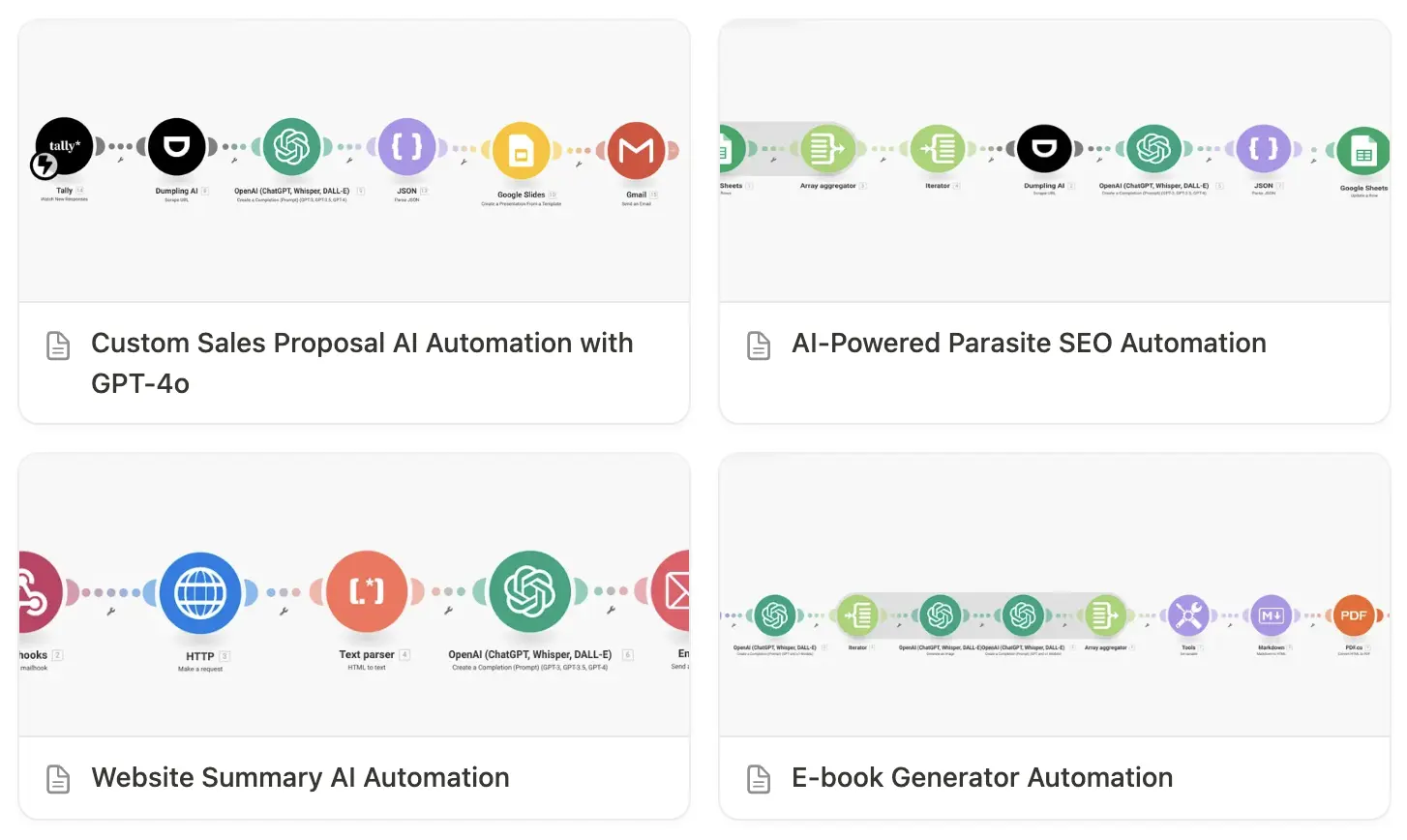
Distribution channels: the Make template marketplace, the n8n template library, ManyChat templates, Gumroad for direct sales, and the Notion template gallery for productivity bundles. The most profitable creators run a portfolio of 5 to 10 complementary bundles for the same audience, which lets them upsell from one bundle to the next.
Why this qualifies as passive income: a bundle built once sells repeatedly through the marketplace ecosystem. Documentation and walkthrough videos make implementation foolproof for non-technical buyers, which keeps support requests low. The income tail is genuinely long when the bundle solves a real workflow problem.
9. Investing in AI ETFs: The Most Passive Income Path on This List
Investing in AI exchange-traded funds is one of the accessible ways to make money work for you, and is one of the most accessible paths for long-term wealth building, and gain exposure to the growth of the AI industry without picking individual stocks. The category has expanded since 2023, with more focused funds available, and the responsible framing matters more than ever in 2026.
AI ETFs work by allowing investors to buy shares of a fund that holds a diversified portfolio of AI-related companies. The fund manager monitors the market and adjusts holdings, which provides diversification and reduces single-stock risk.
Funds worth knowing in 2026:
- Global X Robotics & Artificial Intelligence ETF (BOTZ): one of the original AI-focused funds, broad exposure across robotics and AI.
- ARK Autonomous Technology & Robotics ETF (ARKQ): actively managed, higher concentration in autonomous technology.
- iShares Robotics and Artificial Intelligence Multisector ETF (IRBO): broad multisector exposure, lower expense ratio.
- Roundhill Generative AI & Technology ETF (CHAT): launched in 2023 with a specific focus on generative AI companies, a smart time to use generative AI research tools to evaluate these funds, one of the most directly themed funds for the current AI wave.
A note on responsible framing: financial advisors commonly suggest allocating 5 to 15% of a growth-oriented portfolio to thematic ETFs like these, with the exact percentage depending on your overall risk tolerance, time horizon, and existing tech exposure. Dollar-cost averaging into AI ETFs monthly is the standard approach for managing volatility, particularly given how concentrated the AI sector has become around a handful of large-cap names.
We are not financial advisors and SheAI does not provide investment advice. Before allocating to any AI ETF, do your own research, read the fund prospectus, and consider consulting a licensed financial advisor about how the allocation fits your specific situation.
Why this qualifies as passive income: ETF investing is the most genuinely passive path on this list. Once allocated, the fund manager handles portfolio decisions. Income from dividends and long-term appreciation accrues without your involvement. The trade-off is that the upside is market-correlated, not direct AI income from work you produce. The two paths complement each other rather than substitute for each other.
10. Investing in AI Stocks: Earn Money Online by Backing the AI Revolution
For investors who want more direct exposure to specific AI companies, individual stock investing is the alternative to ETFs. The 2026 version of this section is significantly more honest than the 2025 version. AI does not make you a better stock picker. It can make research faster and more disciplined.
The major AI-exposed companies worth knowing in 2026 include the original hyperscaler set (NVIDIA, Microsoft, Alphabet, Amazon, Meta) plus the now-mature AI-native public companies. Specific companies worth researching include:
- NVIDIA for AI infrastructure and chips
- Microsoft for enterprise AI deployment via Azure and OpenAI partnership
- Alphabet (Google) for AI research and consumer AI products
- Palantir for AI-driven enterprise software
- CrowdStrike and Datadog for AI-augmented cybersecurity and observability
- ServiceNow and Salesforce for AI integrated into enterprise workflows
How AI itself can support investing decisions in 2026: tools like Perplexity Finance, FinChat, Daloopa, and traditional brokerage AI features (Schwab, Fidelity) help screen opportunities, summarize earnings calls, scan regulatory filings, and stress-test assumptions. AI as a research tool, not as a portfolio manager. The asymmetry on AI-driven trading bots marketed to retail investors is brutal, and the products marketed at women in this space have been particularly aggressive. We do not recommend them.
The responsible approach in 2026: dollar-cost averaging into a handful of researched positions, holding for 5+ years, and rebalancing periodically. AI ETFs (section 9) handle this automatically and are the lower-risk alternative for most investors.
Again, we are not financial advisors, and this is not financial advice. The goal of this section is to be honest about what is and is not possible. AI investing can be a real source of long-term wealth. It is not a quick path, and any source telling you otherwise is selling something.
Why this qualifies as passive income: like ETFs, equity investing requires no ongoing work once positions are established, dividends and long-term appreciation accrue passively. The upfront work is the research, the discipline is the strategy, and the income horizon is years, not weeks.

Making Money with AI in 2026: The Best Way to Make Money and Build Passive Income
For those making money with AI today, the honest version of the 2026 AI income landscape is that the easy plays are gone, and the meaningful ones are more specific than ever. AI agents licensed to a vertical, vibe-coded products solving a niche problem, courses with real certification, content sold through an owned audience, bundles solving complete workflows. These all work in 2026 because they combine AI's capability with specific domain knowledge or a specific audience.
The shift since 2025 has been from breadth to depth. The entrepreneurs earning the most are not the ones using the most AI tools. They are the ones who picked a vertical, built deep expertise, and used AI to scale what only they could do. AI is the multiplier. You are still the variable.
If you are ready to build, the AI Bootcamp takes you from idea to launched business in 4 weeks with a working AI agent, a live product, and a 30/60/90-day plan. The Bootcamp is certified by the United Nations' AI for Good initiative. For ongoing learning across the SheAI course library, or to join the AI Sisterhood where members trade what is actually working in their businesses in real time, the doors are open.
Pick one path and start today!
FAQs: Making Money with AI in 2026
Can AI make you passive income?
Yes, AI can make a real difference to your income, and AI can generate passive income through multiple paths, including AI agent licensing, vibe-coded products, AI-powered courses, digital templates, AI-generated art and books, and AI-focused investing. The upfront work is real (typically 4 to 12 weeks of concentrated effort), and the long tail is genuinely lower-maintenance than hourly service work. The categories that work best in 2026 combine AI's capability with a specific domain expertise or owned audience. Calling AI income "passive" in the get-rich-quick sense is misleading. Calling it leveraged is accurate.
How can I start making money with AI?
The strongest 2026 paths are: building AI agents for specific industries and licensing them monthly, vibe-coding niche software products with platforms like Lovable or Bolt, creating expert-led courses with production tools like Synthesia and ElevenLabs, building AI-generated digital products for a defined audience, licensing template bundles on Make or n8n marketplaces, and investing in AI through ETFs or individual stocks. The pattern across successful paths is the same: combine AI tools with deep domain knowledge or a strong personal brand.
What are the best AI tools to make money?
The best AI tools for making money in 2026 depend on the path you are building. For AI agents, Lindy, Relevance AI, and Gumloop lead the no-code market. For vibe-coded products, Lovable, Replit, and Bolt are the strongest. For content and copy, Claude and ChatGPT remain the default and are the most popular AI tools for writing. For visual generation, Midjourney for premium designs, and Leonardo AI as a free high-quality alternative. For voice and multilingual production, ElevenLabs. For chatbots, Tidio and ManyChat are accessible to non-technical builders. With so many AI tools available today, the tool matters less than the audience and expertise you pair it with.
How much can you realistically make with AI?
Realistic 2026 ranges by path: AI agent licensing brings $2,000 to $5,000 implementation fees plus $500 to $2,000 monthly per client, with successful builders running 8 to 15 clients. Vibe-coded products typically earn $30 to $80 monthly per subscriber and scale through the audience. Online courses range from $297 to $25,000, depending on format and certification. Digital products and template bundles range from $49 to $599 per sale. AI-generated art and print-on-demand can earn thousands monthly with a strong niche brand. Affiliate income with a strong personal brand can range from $1,000 to $50,000 monthly, depending on audience size and content output. AI ETF and stock investing returns track the broader market, with the AI sector outperforming most years since 2023.
How to make $1000 a month passively with AI?
To earn $1,000 monthly with AI in 2026, the most reliable paths are: licensing one AI agent to 2 to 3 small business clients at $500 monthly each, selling a $99 to $299 template bundle that earns 5 to 10 sales per month, growing a Substack or Beehiiv newsletter to 100 paid subscribers at $10 monthly, or building a vibe-coded product to 15 to 30 users at $30 to $80 monthly. The path that fits best depends on your starting capability, whether you have an audience, and how much upfront work you can concentrate. Combining two or three streams (a bundle plus a small newsletter, an agent plus affiliate income) is the most reliable way to earn extra income and reach and exceed $1,000 monthly.
What are some AI side hustles and income ideas?
If you want to start making money with AI in 2026 look into building AI-generated print-on-demand products for a specific niche audience, licensing agentic templates on n8n or Make marketplaces, writing and self-publishing AI-assisted books on Amazon KDP, building a paid newsletter on Substack or Beehiiv, creating and selling courses on Teachable or Kajabi, and producing UGC affiliate content on TikTok, Instagram, or YouTube for AI tool partnerships. AI helps streamline every step of this process. The ones that scale best are the ones built around a specific niche audience the creator already understands.
Do you need coding skills to make money with AI?
No. The 2026 AI tool landscape is built for non-technical builders. You can also use AI tools without writing a single line of code. AI agents are built on no-code platforms like Lindy, Relevance AI, and Gumloop. Vibe-coded products are built conversationally on Lovable, Replit, Bolt, and Base44. You simply ask AI what to build, and it scaffolds the code for you. Courses are produced with Synthesia, ElevenLabs, and Coursebox. Chatbots are built on Tidio and ManyChat. The skill that matters in 2026 is judgment about what to build and for whom. Women with deep domain expertise in any field have a genuine advantage here, because the moat is the expertise, not the technical layer.
What AI Skills and AI Coding Are Most Profitable in 2026?
The most profitable AI skills in 2026 are: prompt engineering applied to a specific industry context (not generic), AI agent design and workflow automation on platforms like n8n and Make, vibe coding and AI coding for niche product development, AI-assisted content production and AI copywriting for an owned audience, and the judgment to identify which workflows in a specific industry are worth automating. The pattern is consistent: AI skills paired with a specific vertical or audience are the ones that earn. Generic AI skills without a defined application are increasingly commoditized. The ones who use AI effectively are those who apply it to a specific domain where they have real expertise.
Want to learn how to grow your business or career with AI? Take a look at our courses today!
Stay connected with news and updates!
Join our mailing list to receive the latest news and updates from our team.
Don't worry, your information will not be shared.
We hate SPAM. We will never sell your information, for any reason.
Blog managed by